

Critical Point
A move towards non-violence action.
“He who fights with monsters should look to it that he himself does not become a monster.’
— Friedrich Nietzsche, Beyond Good and Evil.
I had planned to talked about something else today, something I have been working on for months.
But I can’t bring myself to do it.
Because right now, it feels like we are at an inflection point in history.
Two days ago, a long-time friend messaged me to chat about how I was feeling about such divisive times that we are in. We had a long and meaningful exchange.
The next day, I woke up to a message from her saying that Charlie Kirk has been assassinated.
There has been lots of commentaries to this. Here’s one that stood out for me:
Here’s Konstantin Kisin,
The last time I felt like this was 9/11 when it was clear, without knowing the how and the what, that the world was about to change forever. Like the rules of the game had been permanently altered and there was simply no going to back to the innocent, peaceful past.
… to murder a young father simply for doing debates and mobilising young people to vote for a party that represents half of America? This is something else.
This essay isn’t politically motivated. I speak as an outsider to US politics. I am a psychologist, not a political pundit. But my heart sank when I learned that a 31-year-old man, a husband and father to two young kids was shot dead for standing firm for what he believes in, like free speech.
What looks like one of his Proof Me Wrong tour at college campuses, where he invited people to debate him publicly, Kirk spoke to a member of the public and said,
…When people stop talking, really bad stuff starts.
When marriages stop talking, divorce happens.
When civilisation stops talking, civil war ensues.
When you stop having a human connection, with someone you disagree with, it becomes a lot easier to want to commit violence against that group.
What we as a culture have to get back to is being able to have a reasonable disagreement, where violence is not an option.
Liminality
I can’t help but feel like we are now in a liminal space in history.
I cited historians William Strauss and Neil Howe work in my last book, Crossing Between Worlds. They provided a historical analysis based on generational and social patterns. They noted that Anglo-American society enters a new era—a new “turning”—about every two decades. The span of four of these turnings is roughly the length of a human’s existence (80 to a 100 years), which they call a saeculum.
Strauss and Howe notes that “at the start of each turning, people change how they feel about themselves, the culture, the nation, and the future.”
According to Strauss and Howe, the four cycles in a saeculum are
1. High
“The First Turning is… an upbeat era of strengthening institutions and weakening individualism, when a new civic order implants and the old values regime decays.”
2. Awakening
“The Second Turning is… a passionate era of spiritual upheaval, when the civic order comes under attack from a new values regime.”
3. Unravelling
“The Third Turning is…a downcast era of strengthening individualism and weakening institutions, when the old civic order decays and the new values regime implants.”
4. Crisis
“The Fourth Turning is…a decisive era of secular upheaval, when the values regime propels the replacement of the old civic order with a new one.”
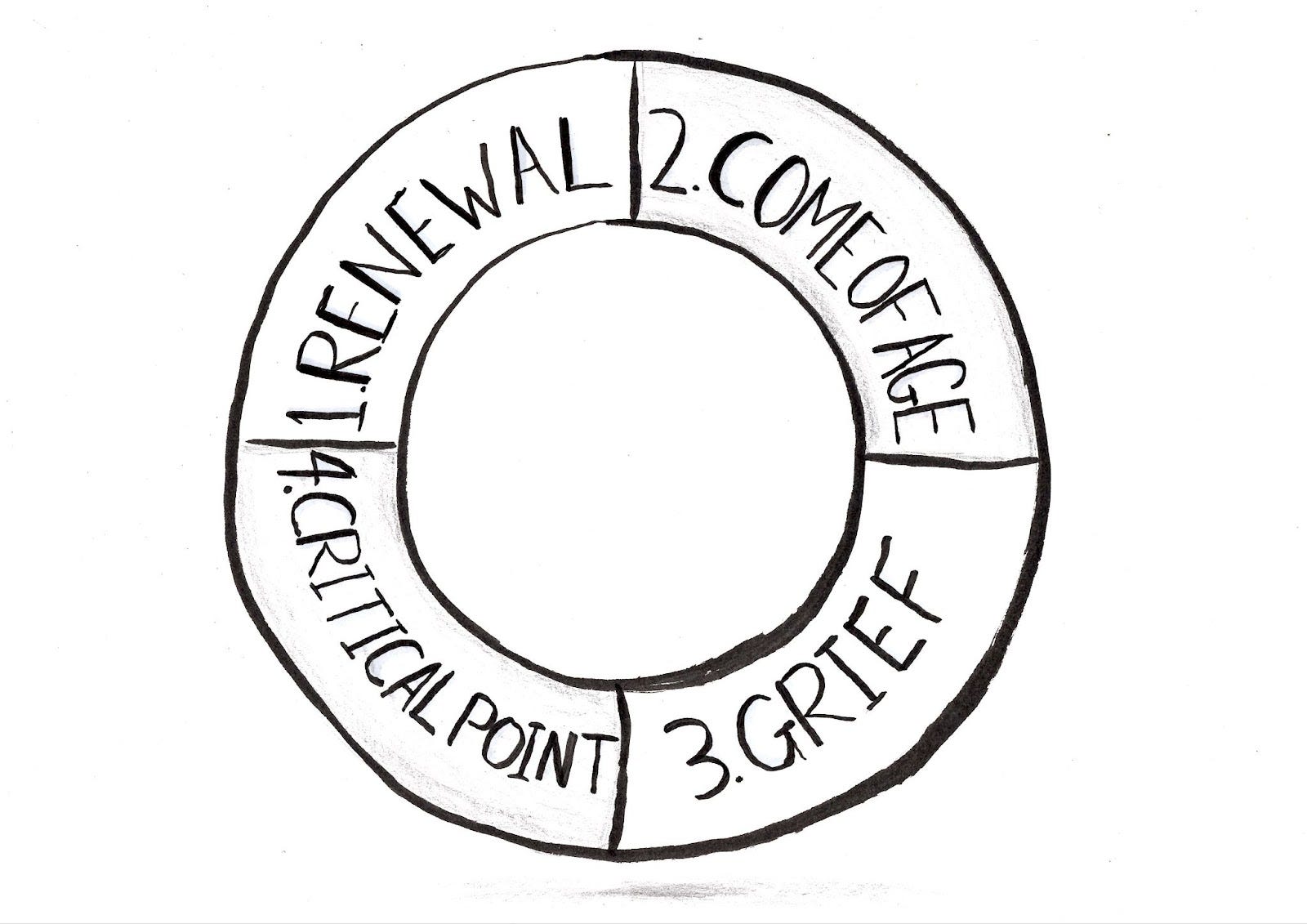
The latin word limen means “threshold.” At this threshold, it feels like we are at the fourth turning, a critical juncture, a crisis point.
At this liminal space, one of the key things is not become a monster.
Non-Violence
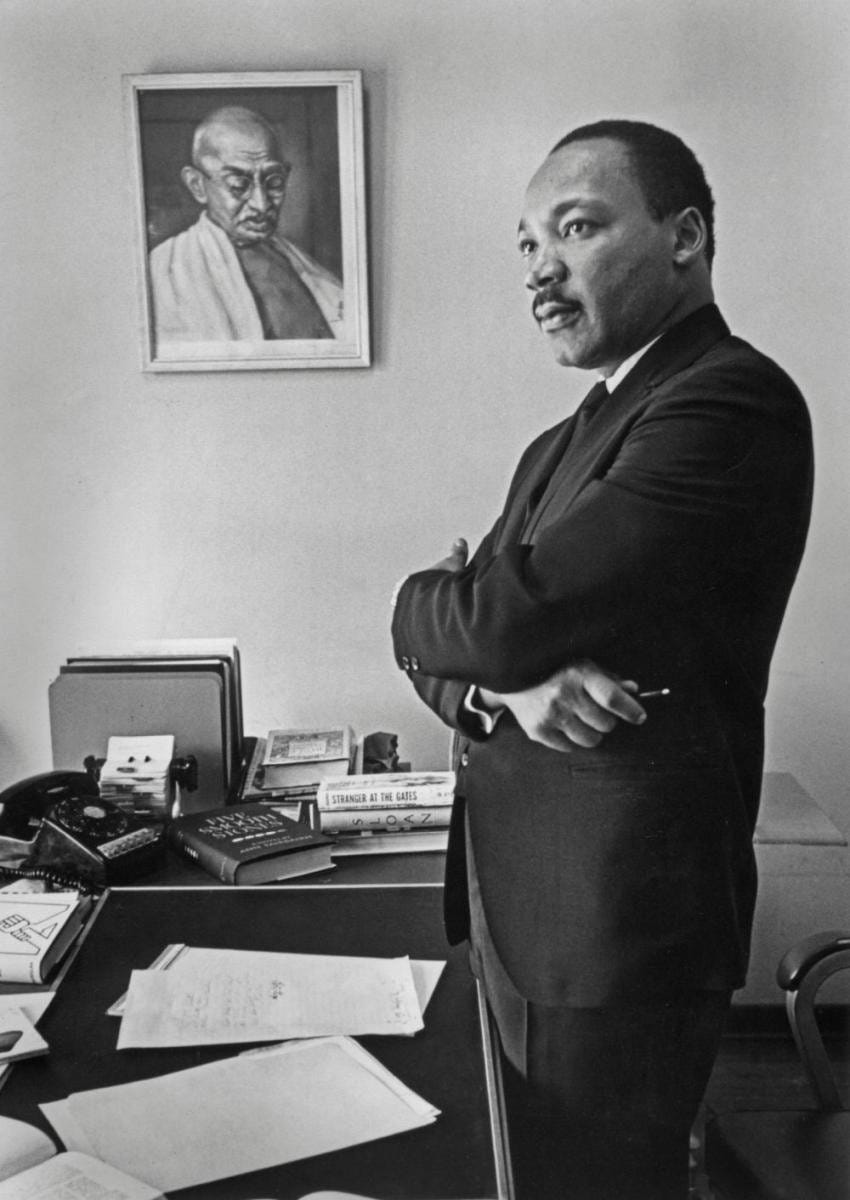
In the early 20th Century, Mahatma Gandhi introduced the concept of satyagraha, a form of civil disobedience, a nonviolent resistance to evil. His nonviolent approach became a major tool to topple British imperialism in India.
In speaking of Martin Luther King Jr inspiration from the teachings of Jesus and Gandhi, Friar Richard Rohr often this meditation on A Nonviolent Love:
Violence does not achieve its own stated purposes, because it only depends the bitterness on both sides. It leaves both sides in an endless and impossible cycle that cannot be stopped by itself.1
A nonviolent practice is not what you do on the outside. If one tried to be nonviolent with people, but continues to be intolerant, highly critical, harsh and punitive on the inside, the person will find it impossible to reconcile the division between the inner and outer life.
I sense that Justice is highly priced in people these days. But if justice is not tempered by forgiveness and nonviolence, we end up fighting monsters between and within ourselves, instead of making any real progress in humanity.
Somewhat counterintuitively, Erica Chenoweth who studied more than 100 years of revolutions and insurrections, notes that nonviolent movements in history were twice as effective than violent resistance.
Dialogue is the lifeblood of real progress. Not just “discussions,” but true inter-dialogue.
I must admit, coming from Singapore, the concept of “free-speech” was rather foreign to me. But from a psychological perspective, I’ve come to see why freedom of speech is so critical for the individual and the collective. Simply stated, speech is an expression of what’s inside.
Can you imagine any real relationship to be without free speech?2
When we speak the unspokens with each other, our trust grows and our relationship grows.
What we have now in much of the online sphere is performative speech. It seeks to shine, but it often fails to connect. It fails to bring you and I closer. There is barely anything social about “Social Media.” True dialogue is missing. The softer voices get frightened away.
When true dialogue takes place, we are prepared to be altered, to be changed.
We need more conversations than ‘conversions’ i.e., less “your-side-versus-my-side.”
In a good faith conversation, don’t start by calling the other a monster, just because we have different points of view. Don’t be too quick to be offended. Speak, in good faith. Listen, in good faith.
You are a multitude. And so is the other.
The sign of our times seems to call for us to return to nonviolent communication, nonviolent action.
May we return to a new turning, one of renewal of humanity. As Charles Eisenstein said, so that we can have a “more beautiful world our hearts know is possible.”
Violence is not an option.
P/S: If you are the praying kind, even if you disagree with his political views, take a moment of silence or prayer for Charlie Kirk’s family that he’s left behind.

Crossing Between Worlds is now available in all formats (paperback, ebook, audiobook) and in all good bookstores. You can also buy direct if you wish to support my work. Big thanks.

Daryl Chow Ph.D. is the author of The First Kiss, co-author of Better Results, and The Write to Recovery, Creating Impact, The Field Guide to Better Results, and the latest book, Crossing Between Worlds.
If you are a helping professional, you might like my other Substack, Frontiers of Psychotherapist Development (FPD).

Just in case you have a negative reflexive thought, I’m not citing legendary figures like MLK and Gandhi as a moralising power play. I’m simply stating that there is a lot to learn from them and nonviolent action.
I can almost imagine a 82 year old man responding to this sentence with “What are I you talking about? With my wife, I’ve learned to shut up so that we can have a marriage! Happy wife, happy life.”
wonderfully said my brother!
Well said Daryl.