

How to Get Organised and How to Decide
Two new modules in HomeKit, the only just-in-time audio kit to get you unstuck, just when you need it most.
We are remarkably limited about two essential yet overlooked aspects of life.
Getting organised and making good decisions.
When asked, “How do you get organised?” most people say use a to-do list.
When asked, “How do you make a good decision?” most people say create a pros-and-cons list.
And when pushed further, most people are stumped as to what else they can do.
Here’s a sample of what’s new inside HomeKit, your just-in-time human companion, to help you get unstuck in sticky situations.
Today, let’s look at Disorganisation and Decision Making.
Listen to the audio above for a full preview of Disorganisation.
Getting Organised
Very few individuals I see come to therapy for the primary reason of being disorganised. Yet, many struggle to steer this messy, multi-facaded, multi-tasking modern life.
Some feel embarrassed to admit this struggle of getting organised on a daily basis. We simply leap into a medical label of ADHD.
This needn’t be the case. There are ways to corral the mess.
Organisation is rhythm and direction.
To be disorganised, is to try and play music with a drummer that has no sense of rhythm and goes everywhere and nowhere.
It’s a cacophonic chaos.
Here’s How:
Here are three strategies to get your life more organised:

Extend Your Mind:
- Use tools to reflect what’s internal to the external world.Create a Pattern in Time:
- A single sound isn’t rhythm. Two sounds might be. Three sounds and your brain is already predicting the fourth. That’s regularity.
- Everything exists in relationship with time.
- Musicians say you are “out of time” means you are not in rhythm.
- How to stay in rhythm? Be clear if you are wearing the Maker Hat or the Manager HatMake Tomorrow Easy
- Be a butler to your future self.
- Defer Rabbitholes
- Build “whitespace” into your calendar
- Multiply activity time by 1.5
- Batching work
- Give 80, not 100 daily.
Listen to the FULL PREVIEW of this module in the native Audio Player above.
Or, go straight into HomeKit platform. Check out the other modules while you are there.
2. Decision-Making
Look at Michelangelo 17-foot statue of David (1501–1504) shaped from a single, 6-ton block of white Carrara marble.

This is what decision-making looks like.
The word “decision” originates from the Latin decidere, meaning “to cut off” or “to determine”. It is a compound of de- (”off”) and caedere (”to cut”).
A true decision is a process of “cutting off” all other alternative possibilities.
Here’s How:

A. For Small Decisions:
‘Satisficing’
- self-imposed constraint that is “satisfactory” and “sufficient,” not maximising for the best choice.
- avoid decision fatigue.Make Big decisions to avoid small decisions
- Taking the time to address repeatable decisions and making them up front.Pre-Decision
- Spell out the criteria for success in advance
B. For Medium Decisions
Adopt a Multi-Track Mind
- un-trap yourself from either/or thinkingExplicate the Opportunity Cost
- Even a weak hint of an alternative, can improve your decision-making.Vanishing Options Test
- Imagine if you cannot choose any of your current options. What would you do?
C. For Big Decisions:
A Mind Needs Another Mind
- If you want to know what someone thinks, stop infecting them with what you think.
- Tips on how to ask for advice without contaminating with your beliefs.Understand Base Rates
- When speaking to an expert, ask about the past, not the future.Sample
- for big decisions, try-before-you-buy.Preferences, Payoffs and Probabilities
- A purely logical decision pros-and-cons does not take into account your values, intentions, and preferences.
- Preferences: Make yours clear to yourself.
- Payoffs: What you gain from the decision and what you lose.
- Likelihood of each outcome: Put a percentage, not just a description.Bonus Strategies:
a. Who do you want to become?
b. Be a good ancestor.
SPECIAL: THE DECISION-MAKING MODULE IS AVAILABLE TO YOU FOR JUST ONE WEEK. CLICK ON THIS BUTTON BEFORE THE FREE PREVIEW ENDS ON 22ND OF MAY 2026.
What is HomeKit

HomeKit is your first aid kit for the moments when you feel stuck, just when you need it.
This series is densely packed with more than 50 areas covered in this audio-series. The wide-ranging topics ranges from Anxiety to Discipline, Procrastination to Motivation, and Guilt to Grief.
HomeKit is your just-in-time human companion to help you immediately shift-state and get unstuck, as quickly as possible.
The Benefits
Quickly help you shift-state, as and when needed to get out of the rut before things escalate.
The collection of these specific principles and strategies are life-skills that are generalisable and a huge payoff to your emotional and relational health, as well as your productivity.
The deep lessons in each segments target specific roots, not abstract labels.
Preview
Each lesson contain three strategies. Sample HomeKit below. I’ve made several of these freely available:
Shame is an innocent emotion. It wants to hide.
Much like when a child covers their face when something's gone wrong.
Anxiety is experiencing failure... in advance. We can learn to recompose and convert the anxiety.
Assertiveness is an act of lessening the divide between what's on the inner and out-life. Because the life that is inside needs to be heard on the outside.
The amateurs have goals. And the pros have a system. A system is how discipline looks like.
In the way that we love, are we loving or wounding others?
We can learn to soften our hardened hearts.
Procrastination happens when we are facing something important on the outside that elicits anxieties on the inside, beckoning us with the question, "Can I face my own frontier?"
There are specific ways to face the resistance in help you get things done.
Stress is a perverted relationship with time.
Develop a good relationship with time and see that stress is not the main the issue. It's the lack of recovery.


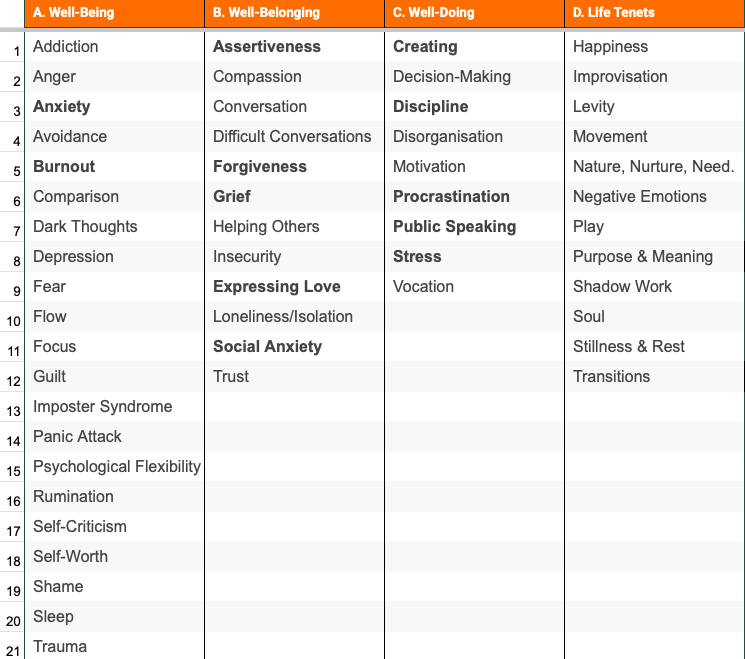
HomeKit is organised into three areas that constitute a good life.
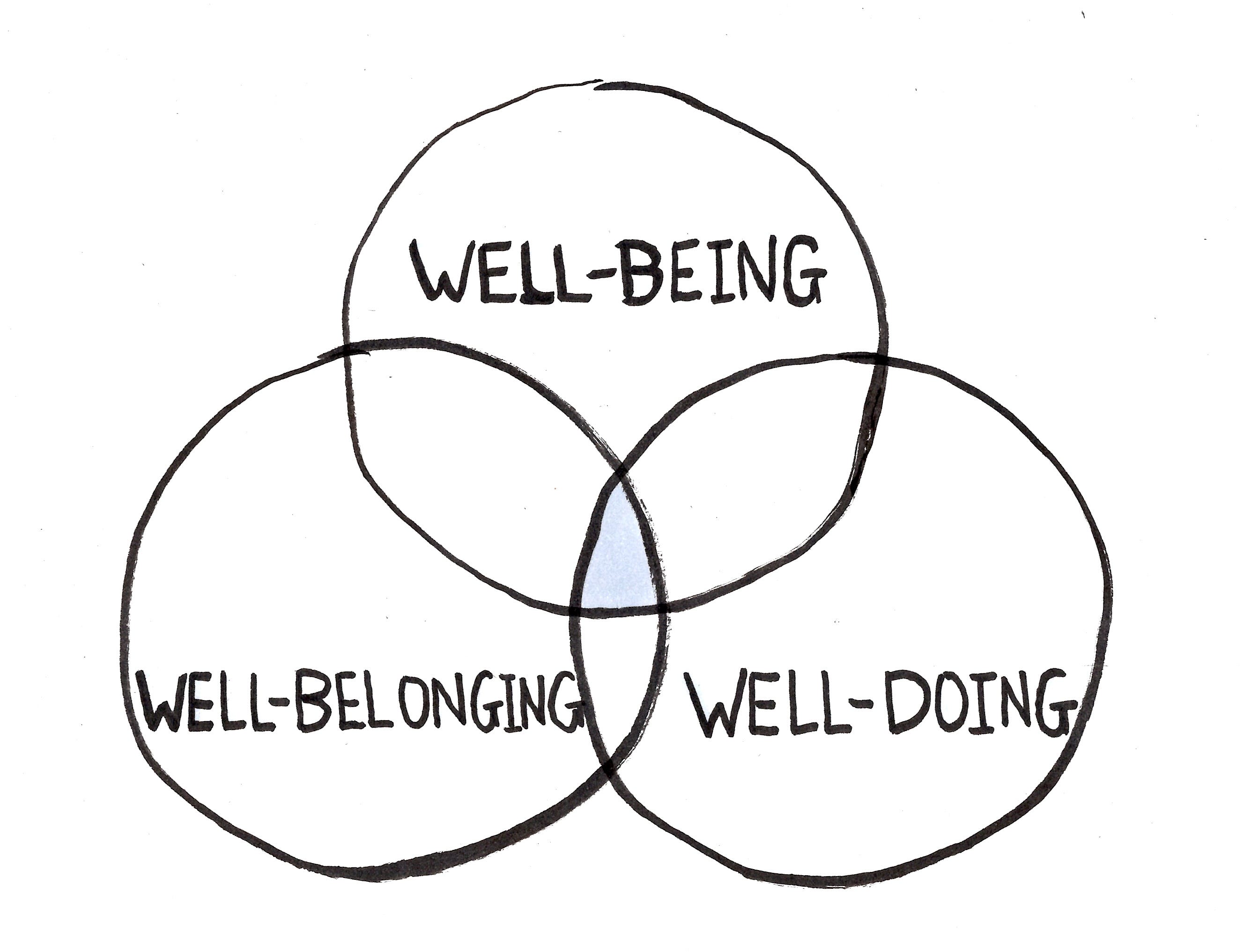
And here is the Menu of HomeKit that is cooking in the kitchen.
Why Choose HomeKit
It's easy to bullshit on a macro level, and much harder to B.S. your way through on a micro level. The chief aim of HomeKit is to target the specifics in a deep way.
When you can zoom in on a higher resolution of issues to address, you will invariably increase your send of agency and control.
When your challenges are more abstract and less well-defined like diagnostic labels (e.g., depression, anxiety, ADHD, trauma), you less likely to get a head-start in improving the situation in your life, simply because the general label, though helpful in some instances, is too general and vague. HomeKit will help you to get unstuck as quickly as possible, and address other related concerns that comes with the territory.
Note: it’s a monthly payment of $26/month for 12 months. Payment stops after, and you’d continue to have a life-time access. The reason for this is so that I can take some time off from clinical practice and record the complete series (> 50 topics) within a year.
Why I Made HomeKit
My job is to render myself out of a job.
I really mean this. This is one of the reasons I’m drawn to writing, teaching, and making things like HomeKit, so that you can make it your own.
So that all of us get a chance to be fully alive in this life.
I’ve been a psychologist in clinical practice for more than two decades, in Singapore and Australia, spanning from working in schools, private hospital, psychiatric institution, outreach, and private practice. I’ve also been training other clinicians in the last decade (see my other Substack Frontiers of Psychotherapist Development).
HomeKit is my distillation, boiling down to essence based on principles and what others have found useful (and surprising).


Every home needs a HomeKit.
Thank you for your trust. I hope you find this useful.
Best,
Daryl

Daryl Chow Ph.D. is the author of The First Kiss, co-author of Better Results, and The Write to Recovery, Creating Impact, The Field Guide to Better Results, and the latest book, Crossing Between Worlds.
If you are a helping professional, you might like my other Substack, Frontiers of Psychotherapist Development (FPD).
